
Tafsir
Choose an ayah and read what the scholars said of it, several at a time.
A study panel that puts the tafsirs of an ayah side by side, with your own notes and your teacher’s.
What it does
The tafsir panel opens with a surah and a range of ayahs, up to fifty at a time. A student can tick up to three tafsirs to read side by side, in tabs for the tafsirs, My notes, Teacher’s notes and Words. The books are the tafsir of Ibn Kathir in eight volumes, the tafsir of as-Sa‘di and Ibn Taymiyya’s Muqaddima on the principles of tafsir, and the index reaches nearly every ayah of the Quran.
Each tafsir shows the first part of its text for the ayah, with a link to read on in the book. The Words tab is a private notebook of vocabulary, and a self-test with no score helps a student check what they have taken in.
How we did it
The panel shows only text that is already in the library. A script made the index from the OpenITI books: it links a heading in a tafsir to an ayah only when the verse text under that heading matches the text of the Quran in the library. Fifty-six headings did not match and were left out, and fifty-eight more are listed for a person to check by hand.
Built today / Coming, not live yet
Built today
- The study panel for a surah and a range of ayahs, with up to three tafsirs side by side.
- The tafsirs of Ibn Kathir and as-Sa‘di, and Ibn Taymiyya’s Muqaddima.
- My notes, Teacher’s notes and a private vocabulary notebook.
- A self-test with no score.
Coming, not live yet
- The Tafsir and Asbab tabs inside the reader are marked coming soon in the app.
- A translation of the tafsirs is not built.
Inside the app
A short drawing of how this part works, one step at a time. The screens come after it.
Choose a surah and a range
A study panel opens on the ayahs you pick.
Compare up to three tafsirs
Ibn Kathir and as-Sa‘di sit side by side, and Ibn Taymiyya’s Muqaddima is there for the method.
Write, then test yourself
Your notes and the teacher’s notes stay apart, a private notebook keeps your vocabulary, and the self-test gives no score.
Screens
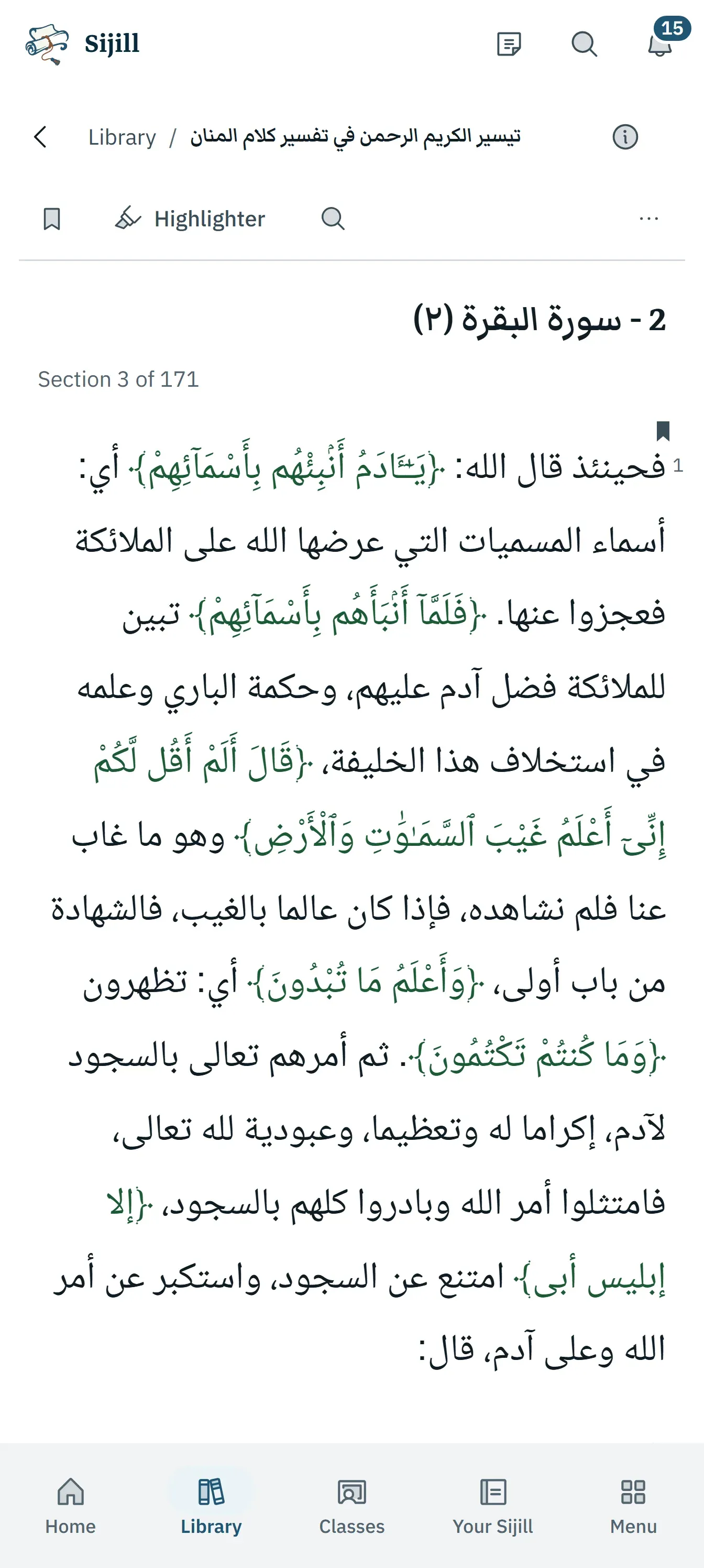
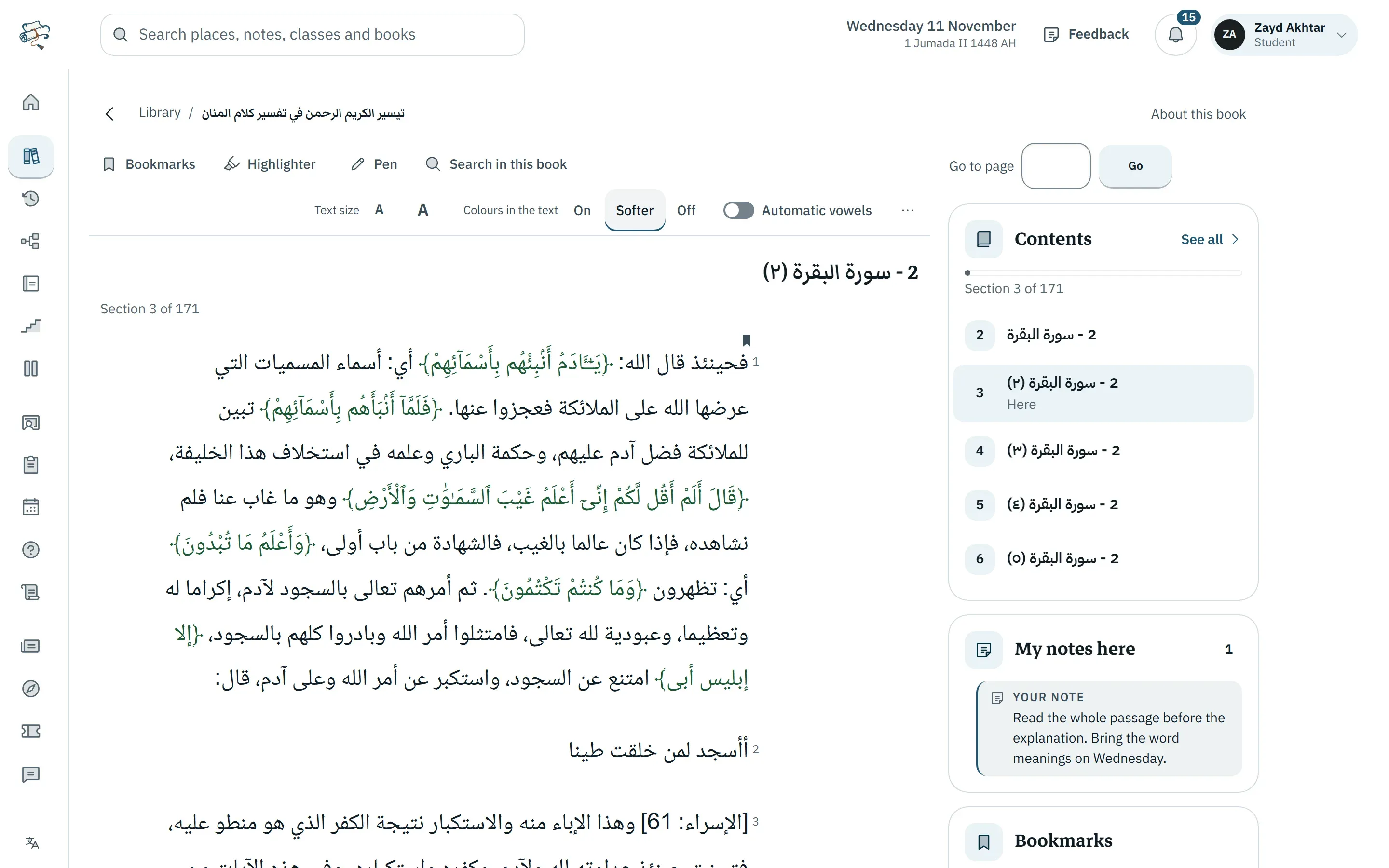
Reading a tafsir. The verses the author explains stand out in green inside the commentary.
The pictures on these pages come from developer copies of the app with stand-in people and sample notes. They are not a real student’s account.
The other subjects
The library and the reader
More than a hundred books to study from, read one section at a time, with your place kept and your own notes beside the text.Read the deep diveHadith and narrators
The six books, the Muwatta and the Adab al-Mufrad, with a card for every narrator that carries the critics’ own words.Read the deep diveThe Quran
The text of the Quran from Tanzil, a card for every word, similar verses, and decks for memorising.Read the deep diveCreed, fiqh and usul
Twenty-three books of creed, twelve of fiqh and three of usul, with study paths, and no rulings of our own.Read the deep diveArabic and grammar
Eight grammar books, a card and a root search for every word of the Quran, and a place to practise i‘rab.Read the deep diveThe seerah and the people
The lives of the authors from the books’ own words, a timeline of sixty-four events, and a map that waits for places we can stand behind.Read the deep diveLive classes
A class room that Sijill hosts itself, with the book beside it, notes tied to the minute, and a record of where the class got to.Read the deep diveNotes, revision and questions
Every note tied to its lesson, teacher, book, page and minute, with revision that returns at the right time.Read the deep diveTeachers, classes and institutes
Join codes, a session log, attendance, homework and grading, certificates that anyone can check, and a view for families.Read the deep dive