
The Quran
The Quran as the text the whole app is built around, taken from a source we can name.
The text of the Quran from Tanzil, a card for every word, similar verses, and decks for memorising.
What it does
Sijill holds the whole Quran, the 114 surahs and 6,236 ayahs. Tap a word and its card shows the form, the root and the type of word, and it says in so many words that it is not a translation. Similar verses are listed together, so that a student memorising one ayah can see the ones that may be confused with it.
For memorising, a student builds a deck and practises it in four ways. A student can also keep a log of what has been recited to a teacher. The log says plainly that it is not an ijaza. A listen bar plays the recitation, and a teacher can set the range of ayahs a lesson covers, so the class opens at the right place.
How we did it
The text of the Quran is the Tanzil text, which is shared with a request for credit, and nothing was typed by hand. The word cards come from the Quranic Arabic Corpus and from CAMeL Tools, two open projects of linguists, and we show where each fact came from.
Built today / Coming, not live yet
Built today
- The whole Quran, with a card for each word.
- Similar verses.
- Memorisation decks with four ways to practise.
- A log of what has been recited to a teacher, marked as not an ijaza.
- A listen bar, and a lesson’s range of ayahs set by the teacher.
Coming, not live yet
- A translation of the verses is not built.
- Other readings of the Quran, with Warsh the first one we are looking into, are at the stage of research only.
- A page view of the mushaf and tajweed colours are not built.
Inside the app
A short drawing of how this part works, one step at a time. The screens come after it.
Tap a word
Every word of the Quran opens a card of its own.
Memorise with a deck
A deck gives four ways to practise, and similar verses are one tap away.
Listen, and keep a log
A listen bar plays the recitation. A log keeps what you recited to a teacher, and says plainly that it is not an ijaza.
Screens
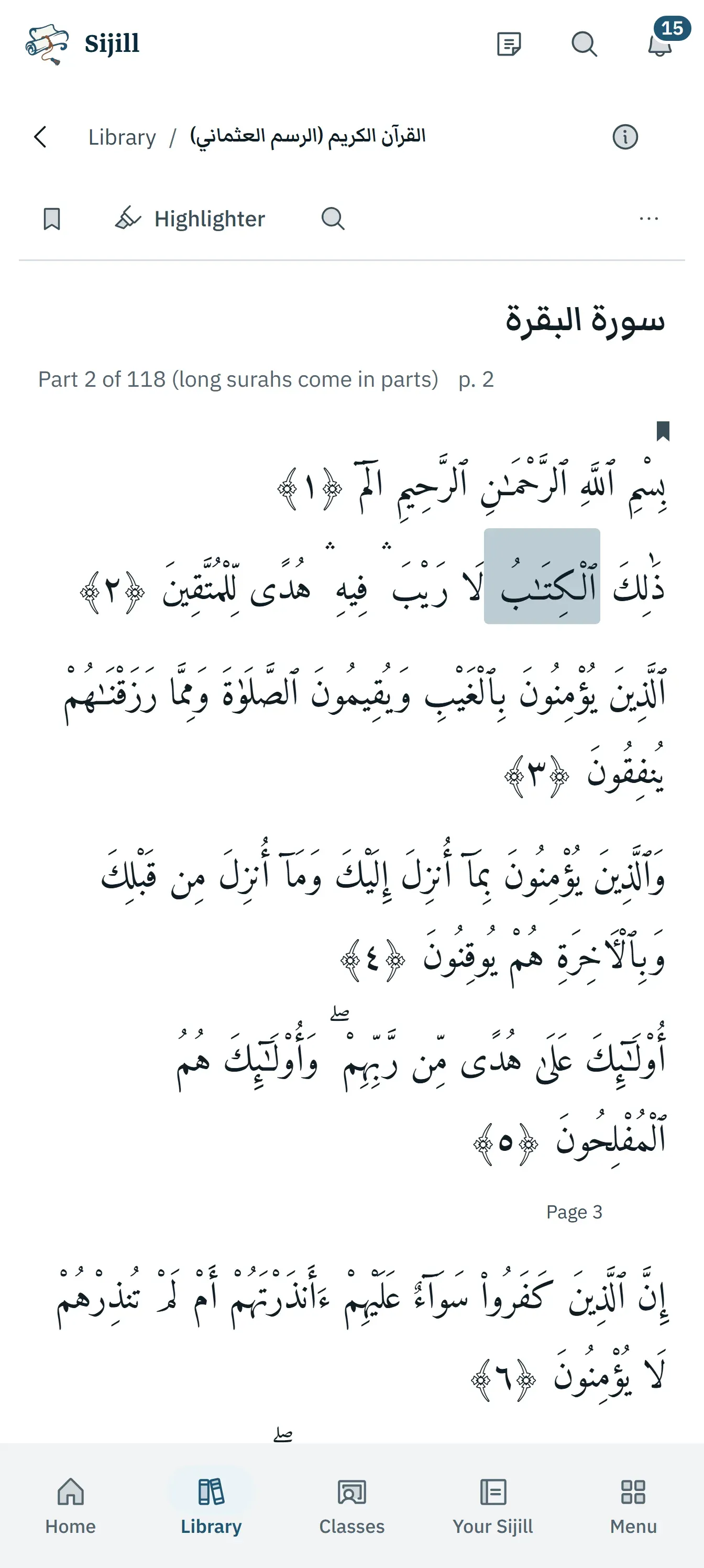
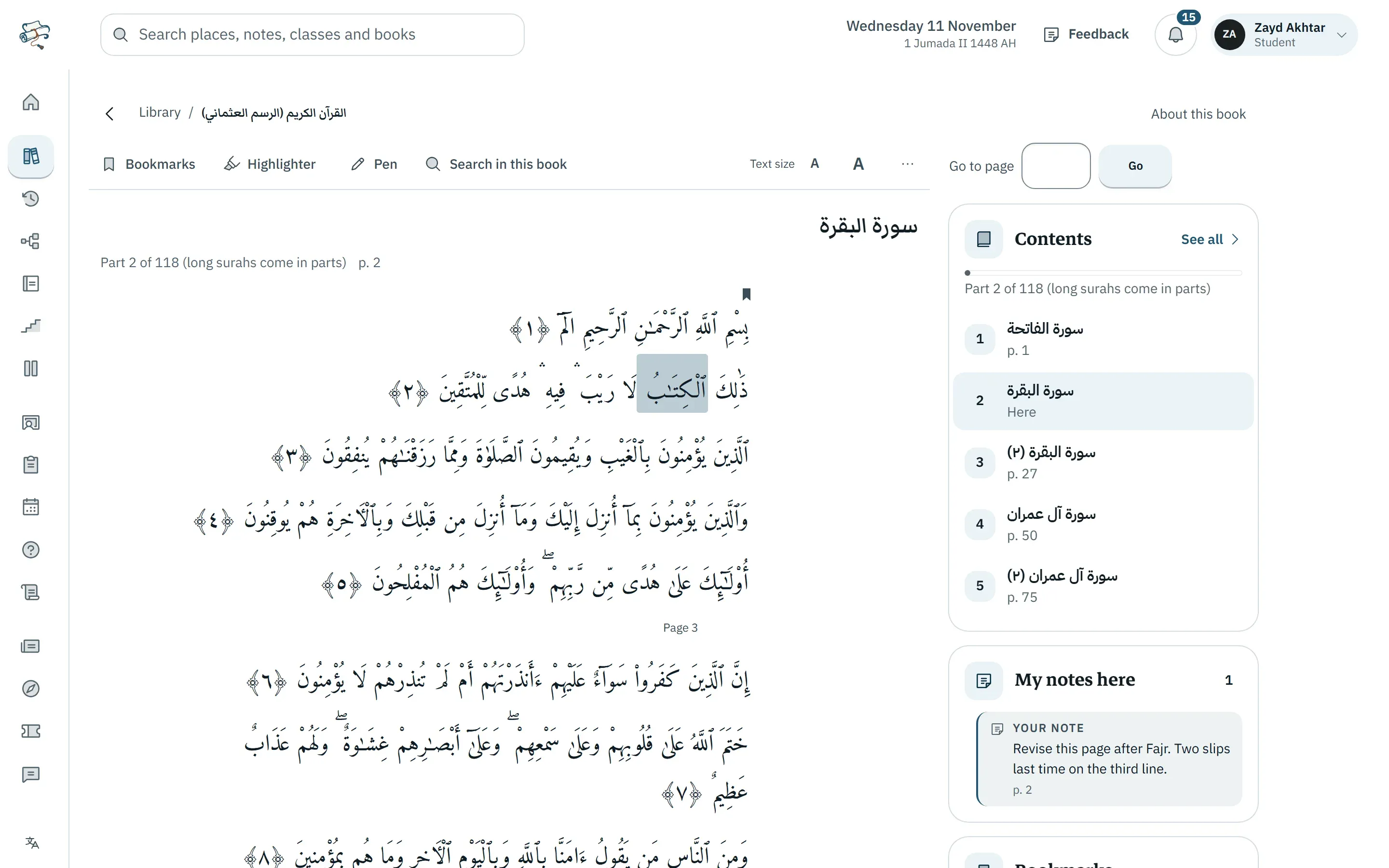
Reading the Quran in the Uthmani script, with the highlighter and the tools of the reader above the page.
The pictures on these pages come from developer copies of the app with stand-in people and sample notes. They are not a real student’s account.
The other subjects
The library and the reader
More than a hundred books to study from, read one section at a time, with your place kept and your own notes beside the text.Read the deep diveHadith and narrators
The six books, the Muwatta and the Adab al-Mufrad, with a card for every narrator that carries the critics’ own words.Read the deep diveTafsir
A study panel that puts the tafsirs of an ayah side by side, with your own notes and your teacher’s.Read the deep diveCreed, fiqh and usul
Twenty-three books of creed, twelve of fiqh and three of usul, with study paths, and no rulings of our own.Read the deep diveArabic and grammar
Eight grammar books, a card and a root search for every word of the Quran, and a place to practise i‘rab.Read the deep diveThe seerah and the people
The lives of the authors from the books’ own words, a timeline of sixty-four events, and a map that waits for places we can stand behind.Read the deep diveLive classes
A class room that Sijill hosts itself, with the book beside it, notes tied to the minute, and a record of where the class got to.Read the deep diveNotes, revision and questions
Every note tied to its lesson, teacher, book, page and minute, with revision that returns at the right time.Read the deep diveTeachers, classes and institutes
Join codes, a session log, attendance, homework and grading, certificates that anyone can check, and a view for families.Read the deep dive