
Hadith and narrators
Every narrator has a card, and every card says what it knows and what it does not.
The six books, the Muwatta and the Adab al-Mufrad, with a card for every narrator that carries the critics’ own words.
What it does
The library holds the six books of hadith, the Muwatta of Imam Malik and the Adab al-Mufrad, together with texts on the science of hadith and the Siyar A‘lam an-Nubala’ in its twenty-three volumes. Beside each hadith, the names in its chain can be opened as cards.
There are more than eight thousand narrators, taken from Ibn Hajar’s Taqrib at-Tahdhib. A card gives the narrator’s kunya and generation and Ibn Hajar’s own words with the volume and page they come from, and it shows plainly whether a qualified person has checked it, yes or no. A button lets any reader report a mistake. Sijill grades no one: it shows what the scholars wrote and where.
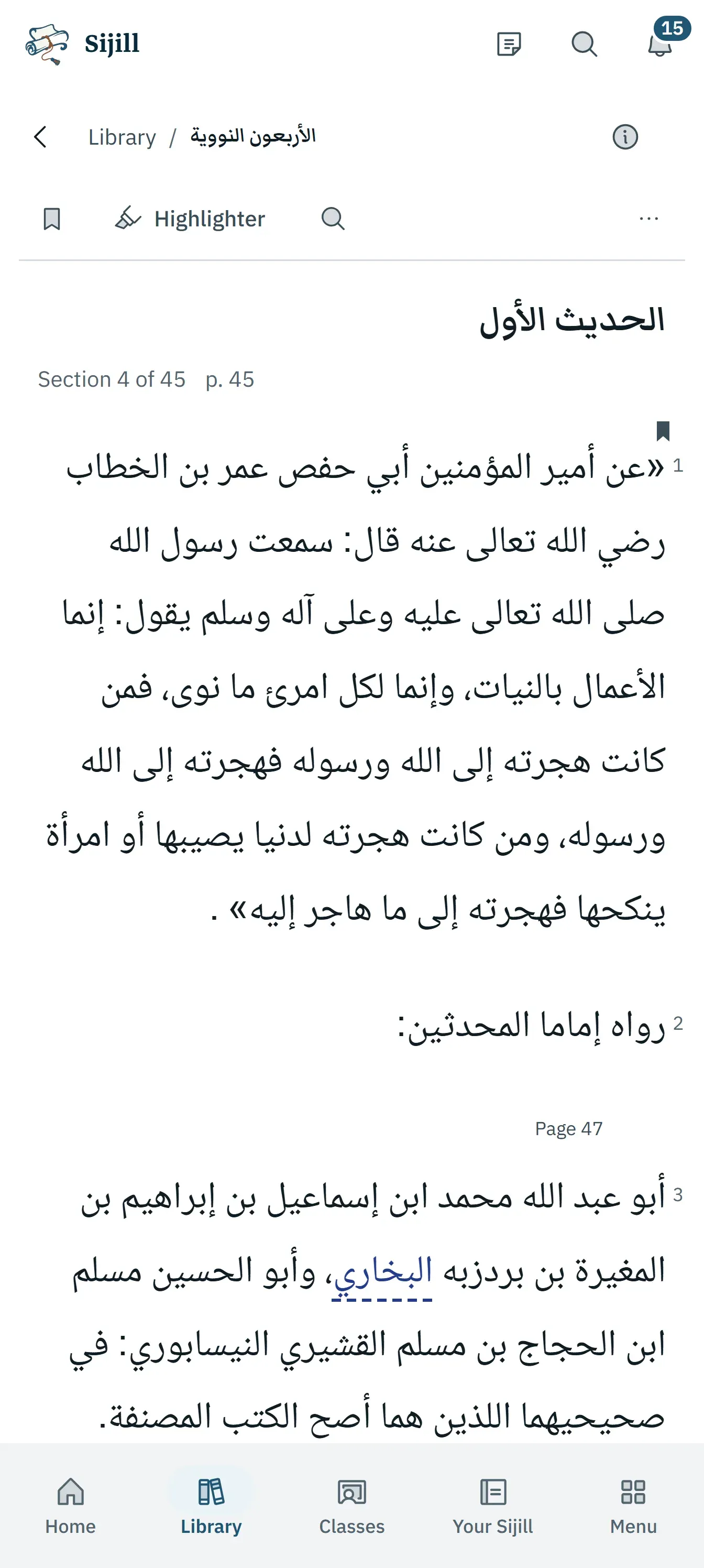
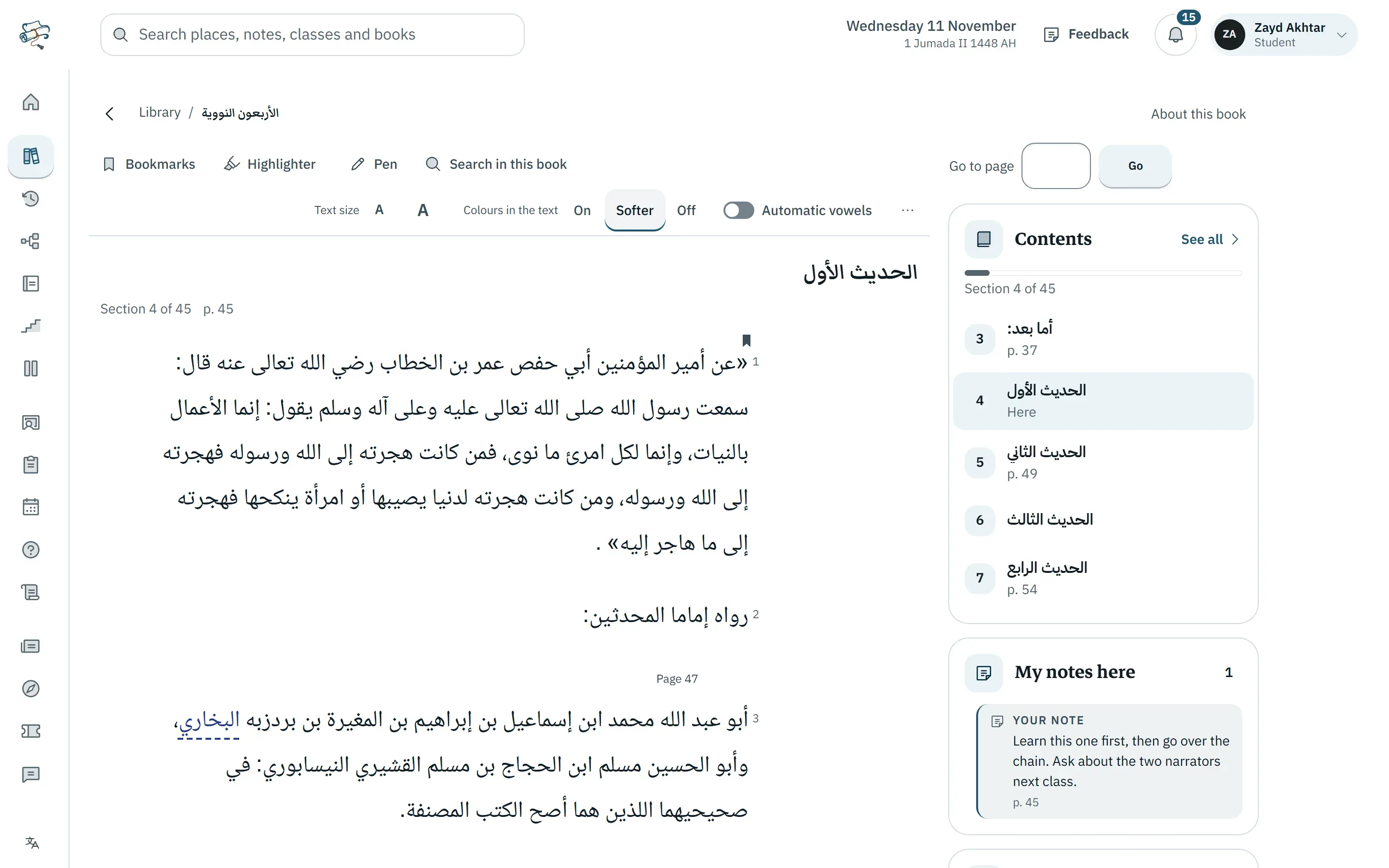
The text can also carry colour marks in six kinds: the Quran’s verses, the Prophet’s words, the chain of narrators, a narrator’s name, a scholar’s name and a book’s title. A name opens its card. You can set the marks to On, Softer or Off, and Softer is how they start, so a student who wants a plain page can have one.
How we did it
The narrators were read from the text of the Taqrib itself, and nothing was typed by hand. When a name in a book can only be matched by its spelling, the card says so in words: matched by name, not checked for this chain. When two narrators fit one name, Sijill shows both and chooses neither.
The colour marks are worked out from each book’s own text, from its verse brackets, its quotation marks and its chains, and from names matched word for word. They are a help to the eye and never a ruling, which is why they start soft and why the cards never claim more than they know.
The chains are the next step. A script reads each chain line in the books’ own text, matches every name to a narrator, and leaves out any name that two narrators could claim. On a copy of the database it found more than thirty-four thousand chains across nine books, and in a hand check of forty chains, thirty-nine were fully right and one was doubtful. This work is finished on that copy and has not been put on the beta yet.
Built today / Coming, not live yet
Built today
- The six books, the Muwatta and the Adab al-Mufrad, with their texts.
- More than eight thousand narrator cards with kunya, generation, the critics’ words, volume and page, and a checked yes or no.
- Report a mistake on any card.
- Colour marks in six kinds, set by the reader to On, Softer or Off.
- Texts on the science of hadith, such as the Bayquniyya, and the Siyar A‘lam an-Nubala’.
Coming, not live yet
- The chain of every hadith shown with its narrators: finished on a copy of the database, not yet on the beta.
- The index of maxims is built and empty for now.
- Commentaries on the hadith books are not in the library yet.
Inside the app
A short drawing of how this part works, one step at a time. The screens come after it.
Follow the chain
Open a hadith and see the narrators who passed it on, one after another.
Open a narrator’s card
Each card gives the kunya, the generation, what the critics said with volume and page, and a checked yes or no.
Set the colour marks yourself
Six kinds of marks help you read the text, and you choose whether they are On, Softer or Off.
Screens
Scroll sideways to see every screen.
Reading a hadith collection. The text is the library edition, with a highlighter and search above it. 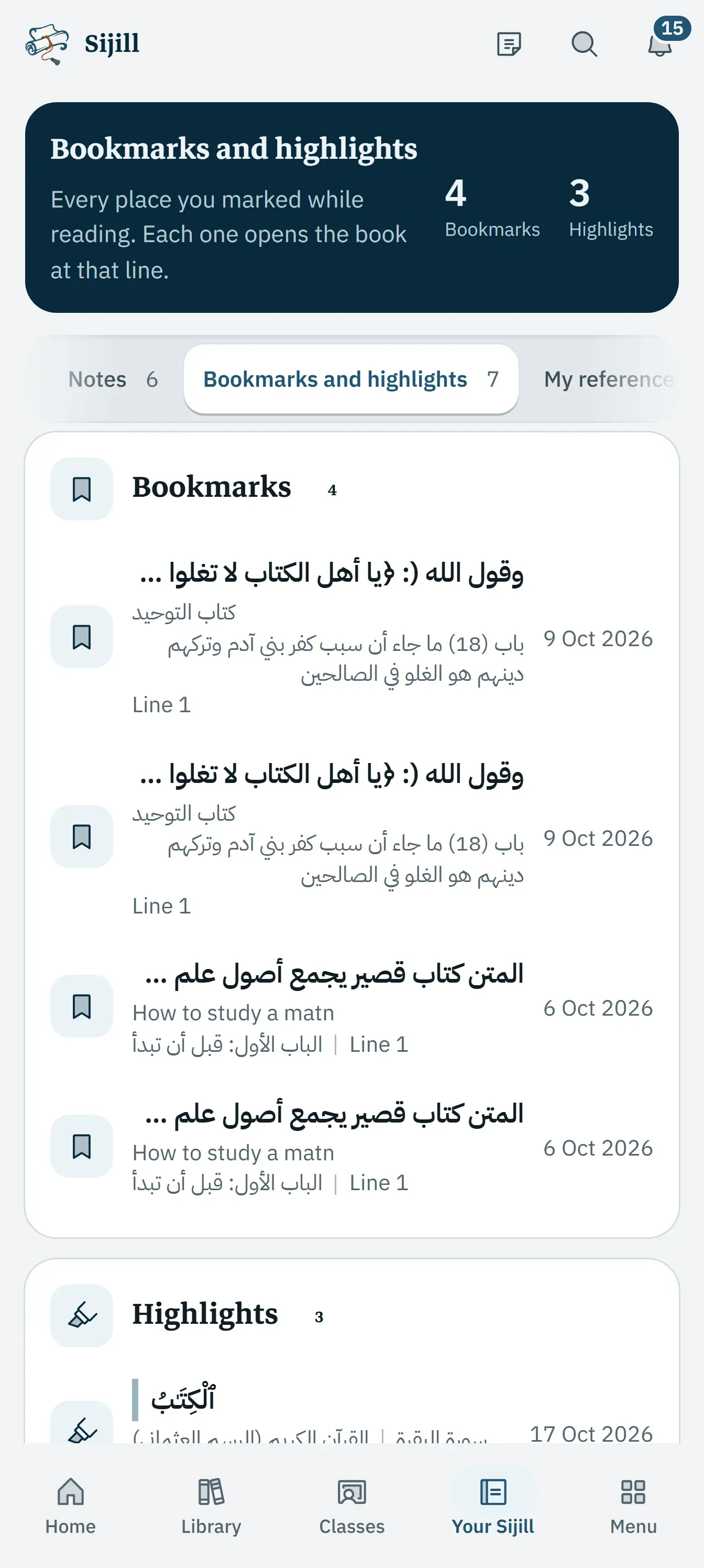
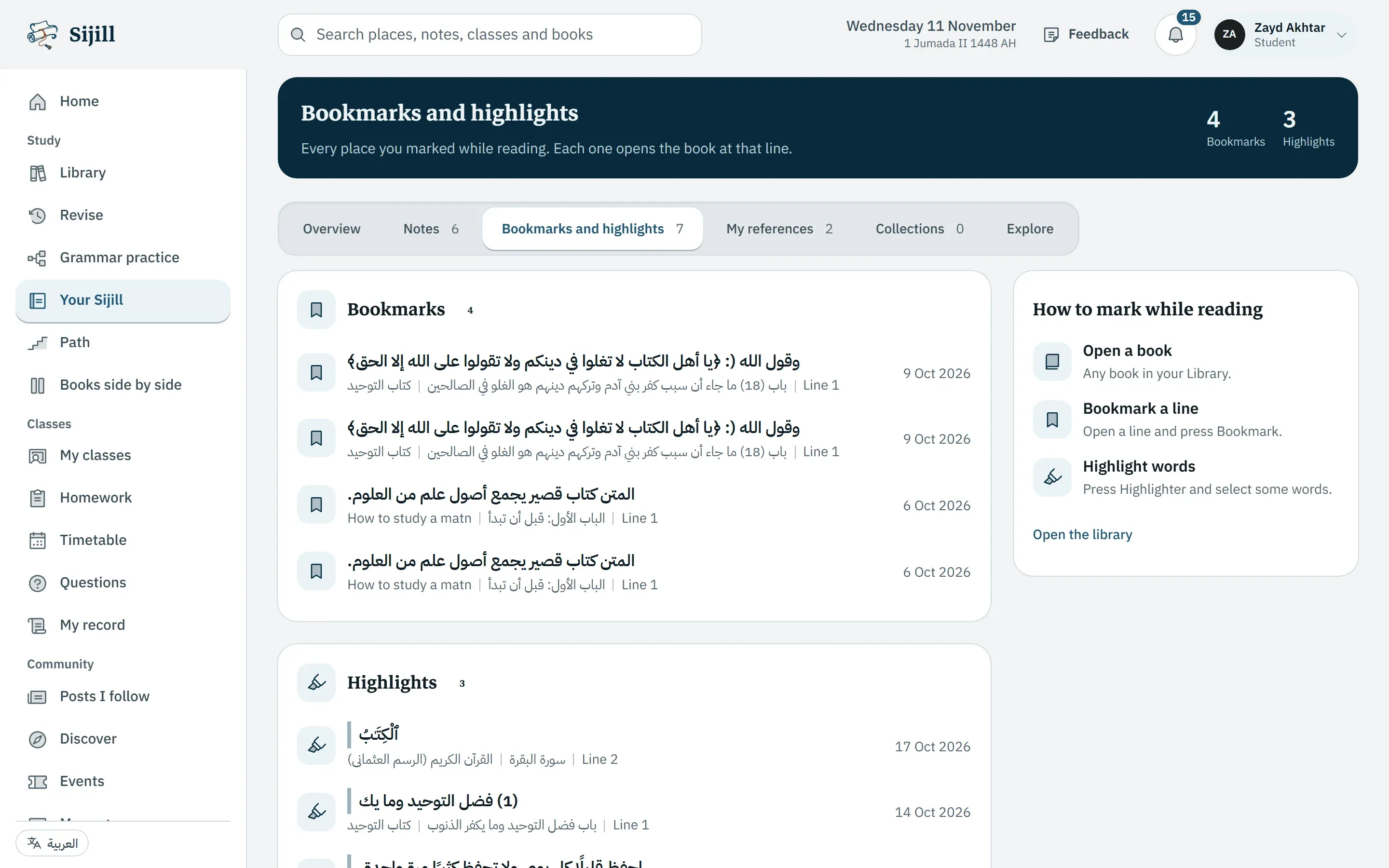
Your bookmarks and highlights in one place. Each one opens the book at that line.
The pictures on these pages come from developer copies of the app with stand-in people and sample notes. They are not a real student’s account.
The other subjects
The library and the reader
More than a hundred books to study from, read one section at a time, with your place kept and your own notes beside the text.Read the deep diveThe Quran
The text of the Quran from Tanzil, a card for every word, similar verses, and decks for memorising.Read the deep diveTafsir
A study panel that puts the tafsirs of an ayah side by side, with your own notes and your teacher’s.Read the deep diveCreed, fiqh and usul
Twenty-three books of creed, twelve of fiqh and three of usul, with study paths, and no rulings of our own.Read the deep diveArabic and grammar
Eight grammar books, a card and a root search for every word of the Quran, and a place to practise i‘rab.Read the deep diveThe seerah and the people
The lives of the authors from the books’ own words, a timeline of sixty-four events, and a map that waits for places we can stand behind.Read the deep diveLive classes
A class room that Sijill hosts itself, with the book beside it, notes tied to the minute, and a record of where the class got to.Read the deep diveNotes, revision and questions
Every note tied to its lesson, teacher, book, page and minute, with revision that returns at the right time.Read the deep diveTeachers, classes and institutes
Join codes, a session log, attendance, homework and grading, certificates that anyone can check, and a view for families.Read the deep dive